Amost a Full Moon 30 April 2026
The full Moon is tomorrow, tonights is at 98% full. I haven't bothered to look at it because this full there is low contrast with no shadows. Most features are harder to make out. Common wisdom is that there really isn't much to see like this. However, I had read that sometimes when the surface is this bright you can see hints of the faint mineral colors. Professional Astronomers use filters and processing images to bring out these faint colors.
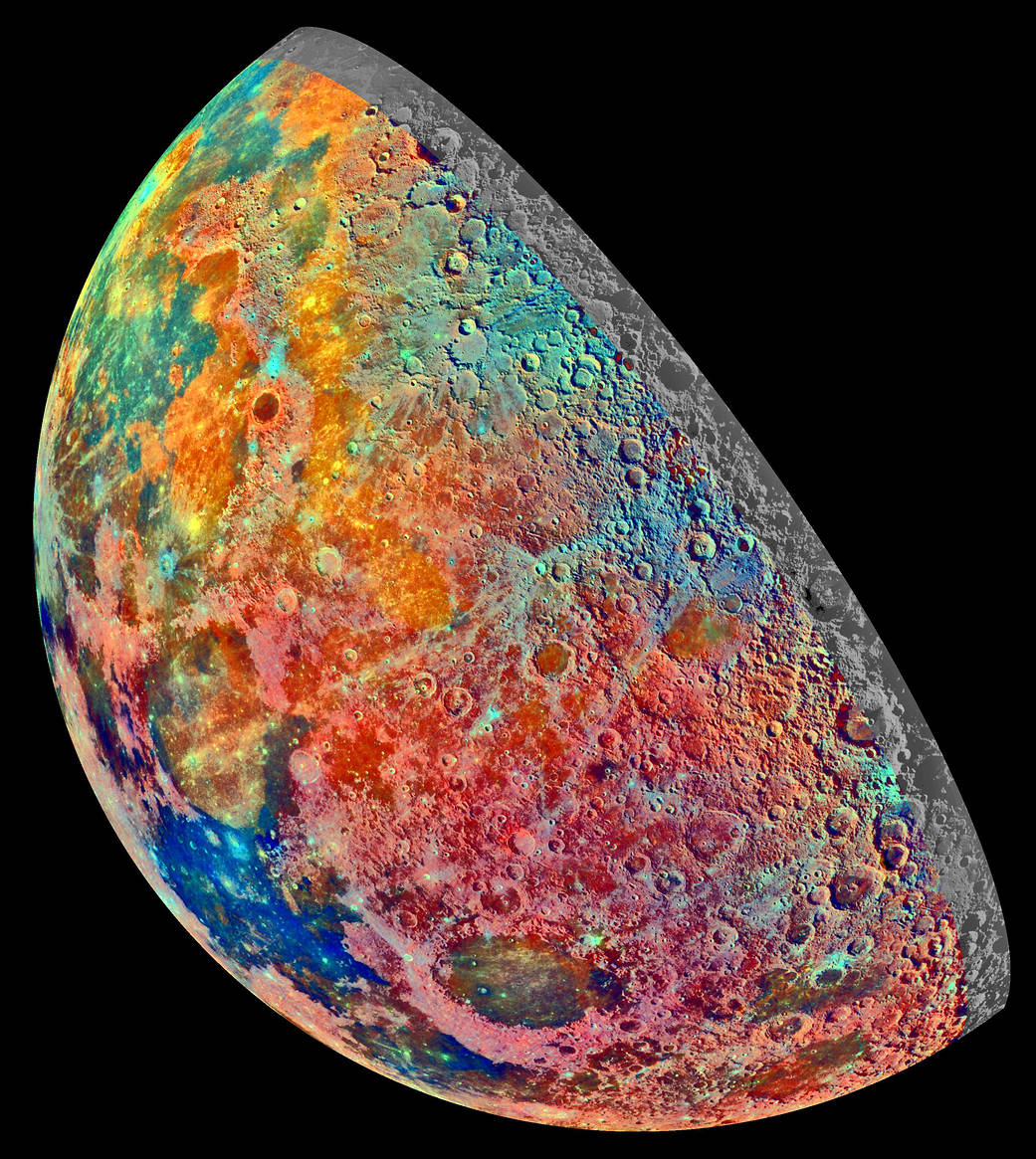
"Even if the moon really were made of green cheese it probably wouldn’t look this bizarre. Still, this mosaic of 53 images was recorded by the Jupiter-bound Galileo spacecraft as it passed near our own large natural satellite in 1992. The pictures were recorded through three spectral filters and combined in an exaggerated false-color scheme to explore the composition of the lunar surface as changes in mineral content produce subtle color differences in reflected light.Image credit: NASA/JPL " https://www.nasa.gov/image-article/mineral-moon/
A search on Google or your favorite search engine will return a lot of links to amateur astrophotographer's images. Most won't be as colorful as this one from NASA. The Artemis II crew took pictures on the far side of the Moon using a Nikon Z9 Mirrorless camera That were stacked and gave a mineral Moon image.
Here's one from Sky & Telescope, https://skyandtelescope.org/online-gallery/mineral-moon-23/
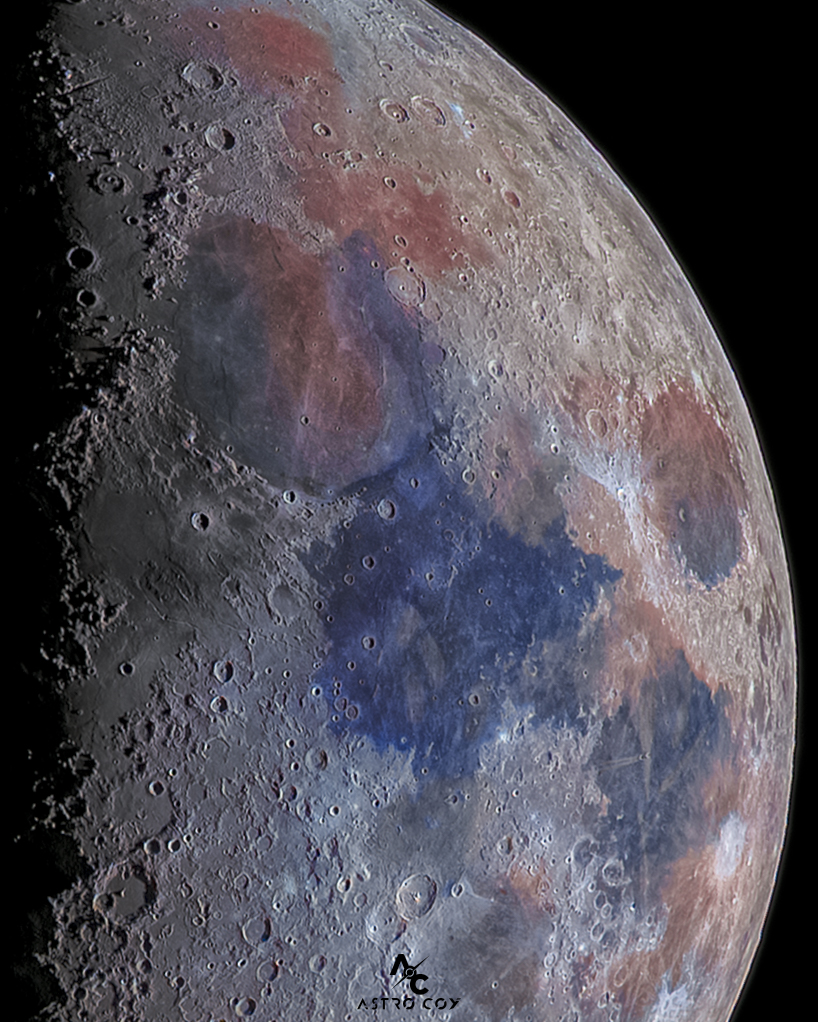
Photographer:
Jordi Coy
Location of Photo:
Morón de la Frontera, Spain
Date/Time of photo:
November, 27, 2025
Equipment:
Nikon Z8 Camera, Lens Nikon Z 800mm, 6.3, Vanguard tripod Veo 5
Description:
A photo that might seem taken with a telescope and a dedicated camera because of the great detail and clarity in the lunar craters and terrain, but to achieve it I only used a mirrorless camera, a telephoto lens, and a tripod from my own home. 100 stacked photos taken at the same moment, each one of 1/250s exposure, ISO 100.
Website:
What isn't mentioned in the link is any processing that was done beyond stacking the images. You can find a lot of information on how to do that online. A lot of the software is free. There is also a lot that is paid.
So back to tonights session. While I obviously wouldn't see anything like the images above, what I read had said that a full moon sometimes made the surface bright enough that a visual observer could sometimes pick up a hint of the colors.
Was set up by 22:11. Using the 25mm Plossl, the Moon just exactly fit in the FOV (Field of View). I observed for a while using this eyepiece. I started at Mare Crisium and worked across to Mare Tranquilitatis, Serenatis, Vaporum, and Imbrium. I kept checking my orientation by noting major landmarks along the way. No colors other than the usual grays and whites were noted.
I tried the 8mm Plossl to see if more magnification would help. at 254x, the edges of the Moon were boiling a little. I could barely focus on the edge and away from the edge the view was fuzzy enough that I couldn't really get a good focus. I was also having some issues with small floaters in my eyes.
Switched eyepieces to the 25mm with a 2x Barlow, about 162x. This focused better. I turned the diagonal clockwise so the eyepiece was pointing horizontally. Did this so I could sit on the stool comfortably while observing. This flips the image top to bottom instead of right to left. It took a little getting used to since I normally don't do that.
I looked at Tycho and it's ray. There are two prominent parallel lines running at 45 degrees down and to the left in the eyepiece. I think that would make them actually running to the NE(?). They are very distinct and look like ridges. The ejecta field from Tycho is very evident. There are a lot of smaller craters that show up as very bright white spots or rings against the duller white background.
The view with the almost full Moon is much more impressive than I had expected. Still no mineral colors though.
I shifted back to Mare Crisium to orient myself again, then over to Mare Serenatis. ID'd crater Poisidonius. Interestingly there is a light colored ray almost perfectly bisecting Serenatis. It starts near crater Menelaus and passes through another small crater (Bessel?). In the eyepiece the upper third is brighter, and it dims as it gets near the edges of the mare.
I am constantly amazed at how perfectly circular some of these craters are, such as Poisidonius and Plato. In what is effectively a full Moon, they show up as very bright amost perfect circles on the slightly dimmer background.
Looking at this bright a Moon without a filter leaves my eye dazzled for a few minutes when I move away from the eyepiece. I added the filter, but still no sign of color other than the normal shades of gray in the mare and highlands.
I decided to try and see if I could still see any DSOs (Deep Space Objects) with the Moon this bright. Common wisdom seems to be it's not worth it. At 23:15MST I did a Skyalign using Vega, Arcturus, and Alphard. Checked alignment by going to Castor and it put it right in the FOV. Went to Denebola, a wide double in the 25mm eyepiece with the 2x Barlow. Both stars appeared white to me. Then went to M3 a globular cluster. The goto put it just outside the initial FOV of the 25mm eyepiece. When I centered id it was just an indistinct fuzzy ball.
Lessons learned:
Common wisdom about observing during a full Moon is not necessarily correct. I can see how dim DSOs would be washed out, and even in bright ones like M3 details can be washed out. That doesn't mean it's not worth trying, especially for something that might have alimited window for observing.
For the Moon itself, there was still a lot of detail to see. It also provides a totally different perspective on many features. So I won't skip a clear night to observe just because it's a full Moon!

Comments
Post a Comment
Please leave a comment on my content when you visit this blog. Comments are moderated, but I do read them all. Thanks!