Posts

23 December 2024 and 7 January 2025

  On 23 December, the sky was mostly clear for a change so at about 21:30MST decided to try for Mars.  I waited until then because that would put it about 10 degrees above the mountains to our east. The temperature was 33deg F, RH 82%, and some frost was starting to form. Got aligned using the 24mm reticle eyepiece, then moved to the 17mm Plossl, then the 17mm with the 2x Barlow. A high thin layer of clouds moved in before I could get focused. it obscured most of the stars. It obscured most stars, and Mars wasn't discernible. Jupiter could be located by eye, but was just a fuzzy ball. I packed up at 22:30. 7 January was a little different. We had our first clear night in  several days, so I thought I'd try for Mars again. Set up at 20:30MST, temp was 27deg F. Moon was waxing gibbous, about 63% illuminated. There was a few inches of snow on the ground. Mars, Venus, Saturn, and Jupiter were all visible and bright.. Transparency was fair. There was a lot of moisture in the a...

The Moon and Jupiter 10 Dec 2024

Image
  Sky was looking clear so I set up about 19:30 MST. Plan was to just look at the Moon and then Jupiter. I used Solar System Alignment with Jupiter for the alignment target. I messed up and put the date in as Dec 12 instead of Dec 10! I didn't realize what I had done until later. GoTo was obviously off  because of that, but tracking was good and I was able to scan over to the target, Moon was at 77%, very bright, and was the first target for observation. Just after I got aligned and moved to the Moon a layer of cloud started moving in from the northwest. it eventually mostly obscured Jupiter. It kept moving SE and didn't affect the Moon. I initially had the 32mm eyepiece in just to scan and look for interesting features that might catch my eye. I didn't have the Moon filter in to start, but it was so bright it left an after image in my eye when I looked away. I put the filter in to make it easier to look at. I started looking along the terminator and the rim of Montes Jura ...

26 September 2024

Image
 Tonight was a little bit of an exercise in frustration. Starting about 20:0 0MDT I tried setting up the tripod and leveling it before attaching the mount and then the telescope. In the process, I bumped the tripod and knocked it out of level. Grrrrr! I eventually got everything set, and was able to successfully bring targets into the field of view. I am really looking forward to getting a permanent pier put together!  Skyglow was pretty bright despite the Moon not being up. Seeing was fair. Transparency wasn't great, with a NELM (Naked Eye Limiting Magnitude) of about 4.  The first target was M2 , a globular cluster in Aquarius. It is about 55,000 light years away and contains about 150,000 stars. I was only able to make out a couple of individual stars on the periphery by using averted vision.     Second set of targets wee from the AAVSO class. Z Andromeda and AC Hercules. Hercules was just past zenith. That is a difficult angle for me to see with the red dot ...

24 September 2024

Image
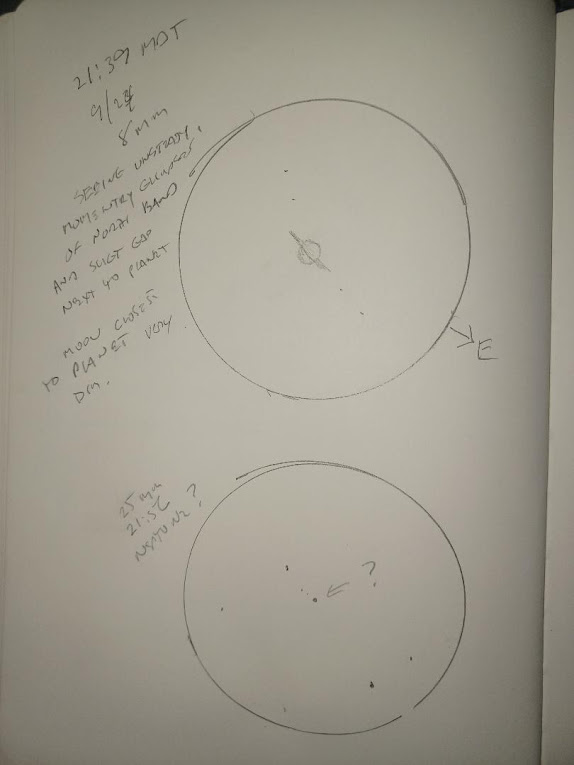
Tonight was clear enough that I set up my telescope. Set up at 21:00 MDT, and aligned using Altair and Polaris. GoTo was still consistently off to the left in the east part of the sky, but was able to use the RDF to get on target. I am obviously missing something in set up. The most obvious suspects are date and time entry.  Transparency isn't real great and the sky was pretty bright, so I decided to just try some easy observing to relax.  I hadn't done any planet observing in a while, and Saturn was up. I started with the 25mm eyepiece and progressed to the 8mm. The rings are almost edge on, just a little tilt to them. Seeing wasn't real steady, but there were moments when it steadied. I could make out a very thin dark space between the rings and the planet on either side of the planetary disk, And could easily make out the rings in front of the planet. The north atmospheric band was occasionally faintly visible. There was no real discernible color. The planet appeared whi...

More AAVSO stuff, and ramblings

Image
     I have been working on my third AAVSO CHOICE class, "Developing a Visual Observing Program".  The course ran from August 5 to August 31, but they gave us an extension for a week because a lot of the participants were experiencing bad weather and or smoke from wildfires.  I took this course hoping to learn more and improve my visual observing skills. The coursework involved using charts created using the AAVSO's VSP (Variable Star Plotter) program. This is accessible from the AAVSO home page and you don't have to be a member to use it.    There was also a set of practical exercises that typically involved using charts and atlases to locate a target by starhopping, and at least identifying the star field where the target star was located. I found these exercises to be great practice when I had a night that I could actually practice. Most of the month we had bad smoke fro wildfires in California, Idaho, and others within 20 miles of us. This was...

Perseids and Aurora, 11-12 August

Image
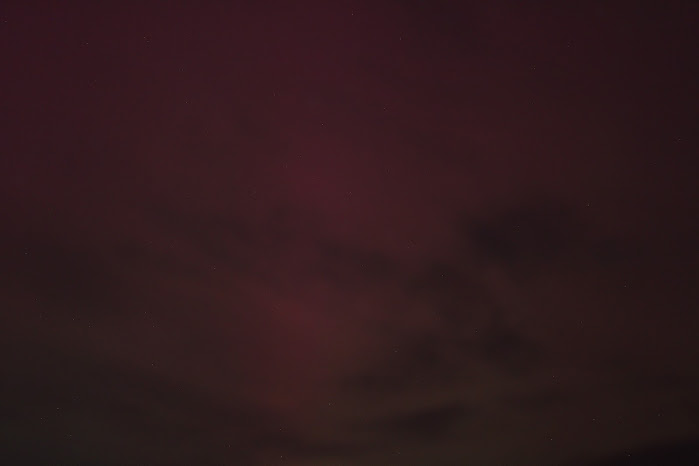
  Photos taken with Canon EOS Rebel T7, kit 18*55mm lens, ISO 1600, F4.8, 15 second exposure,  Went out last night  at about 23:00 MDT, Hoping to watch the Perseid meteor shower. On my way out, Anne reminded me that the Aurora Borealis was supposed to be visible from our location tonight. I set up a lawn chair looking NNE towards where Perseus should be. The Aurora was covering that part of the sky all the way up to the bottom of Cassiopeia. It extended from the NNW to the East.Visually, it looked like a large grey/white cloud, and could easily be mistaken for one. In fact, I'm sure I have in the past. Through my night vision scope there was occasional structure ( vertical striations ) visible. I tried to take some pictures with my phone camera, but it isn't well suited for that type of imaging. Cell Phone Photo looking East. You can just pick out a hint of the red. The Aurora created quite a bit of skyglow. We also have quite a bit of smoke from wildfires. The smoke exac...

Library Telescope!

Image
 Our library ( The Darby Community Public Library ) has a small telescope available to check out. It is part of an outreach program by the Western Montana Astronomical Society . They supply small telescopes to several libraries in western Montana. The one in our library is an Edmunds Astroscan.    Telescope kit. Astroscan, 28mm and 12mm eyepieces, Rigel Quickfinder, Nightwatch  and Night Sky references and star charts. Red duffel bag to carry it all.  They are an older reflector telescope, with a design that originated back in 1976. The Edmund Scientific company used to be a ubiquitous supplier to technical and scientific hobbyists of all kinds, The Astroscan was designed as an entry level, easy to use telescope. The base is a ball and rests in a cradle with pads that allow it to be aimed easily, but it is balance so that it will stay put where it is aimed. There have been larger amateur built telescopes that use essentially this same type mount. It is a form of...